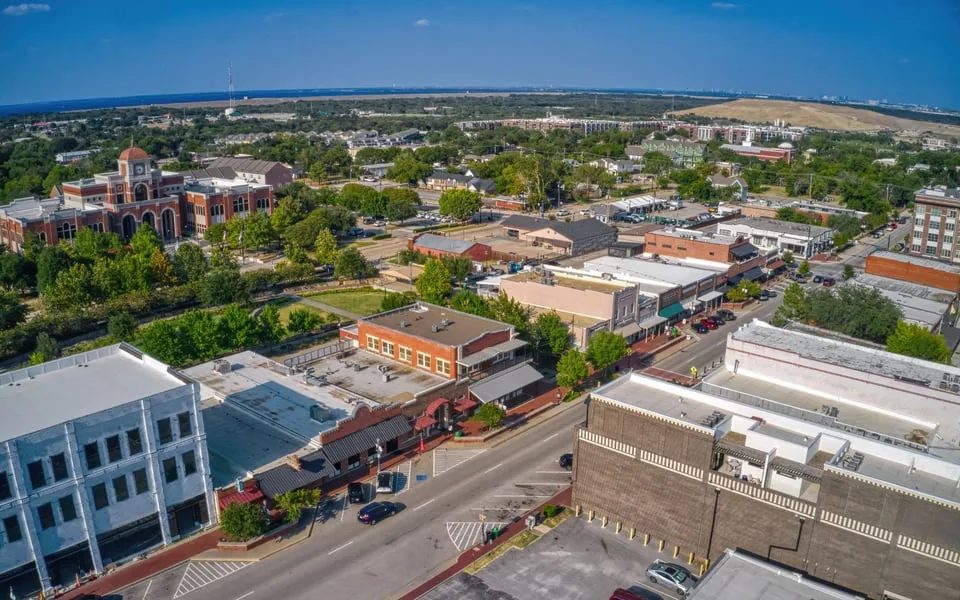
Failed Flashing Repair in Lewisville, TX
Home // Roof Damage Repair //
Overview
Failed Flashing Repair in Lewisville
Mark the stain, then walk uphill. On a flashing report, the ceiling mark shows where water came out, not where it went in, and the entry point is usually at a wall termination, a curb or a pipe boot somewhere above and to the side. The first inspection pass in Lewisville, TX follows the stain along the deck line, photographs each termination on the way and records the one where the evidence points.
Flashing is the part of a roof that moves most. Metal expands in the heat, walls shift, equipment vibrates and sealants age. Regional airport summers run close to 96 degrees Fahrenheit, with twenty-some days a year at 100 or above, so every joint on a Lewisville roof works through a hard season of expansion and contraction.
Dates give the record its force. Each photograph carries a date, a roof zone and a direction, and each probe result names the tool used. A later visit can then repeat the same shot and show whether a gap has widened, whether a sealant line has cracked further or whether a repair is holding.
Inspection record: wall terminations and counterflashing
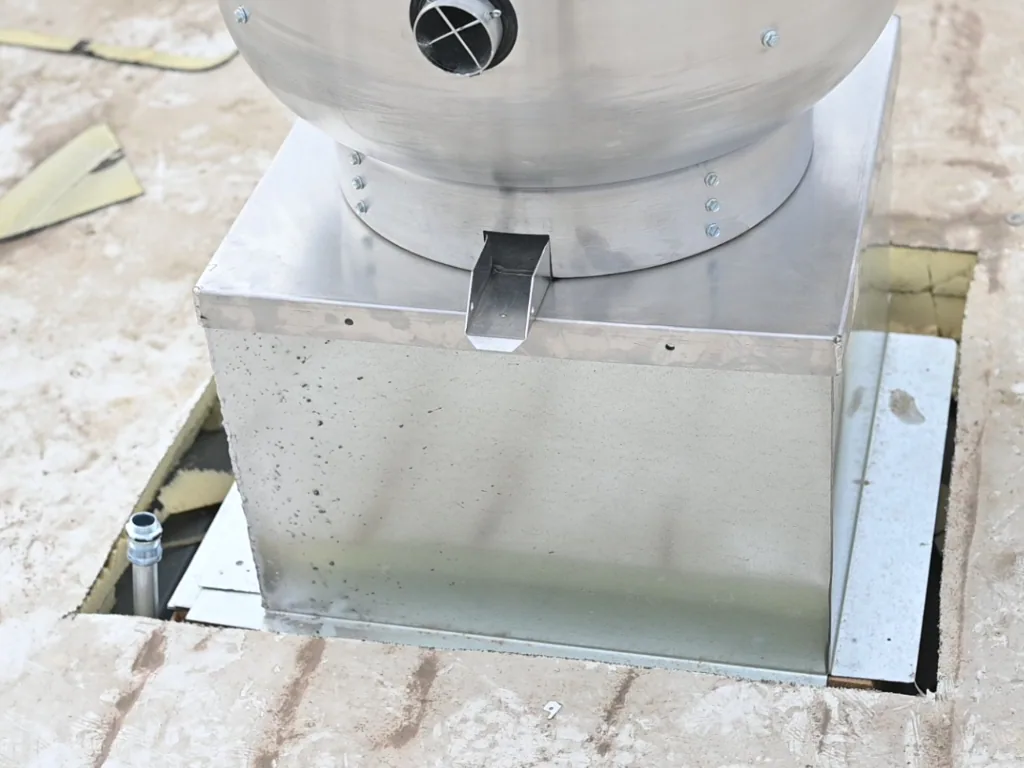
Where a roof meets a wall, the base flashing turns up the wall and the counterflashing laps over its top. We measure the height of the base flashing above the membrane, tap along the counterflashing for loose sections, check the termination bar fasteners and look for cracked sealant along the top edge. Each finding gets a photograph and a position on the roof plan.
Common faults are a counterflashing pulled from its reglet, a termination bar with backed-out fasteners and a base flashing too short for the water depth a heavy storm can produce. A flashing that was sound last year can fail after one season of thermal movement, which is why the dated photograph matters more than the memory of an earlier visit.
Parapet caps deserve the same walk. Water that gets behind a cap runs down the inside face of the parapet and appears at the termination below, where it looks like a flashing fault. The fix is at the cap, and the record says so, which keeps the repair boundary from growing over sound flashing.
Attachment detail: curbs, boots and penetrations
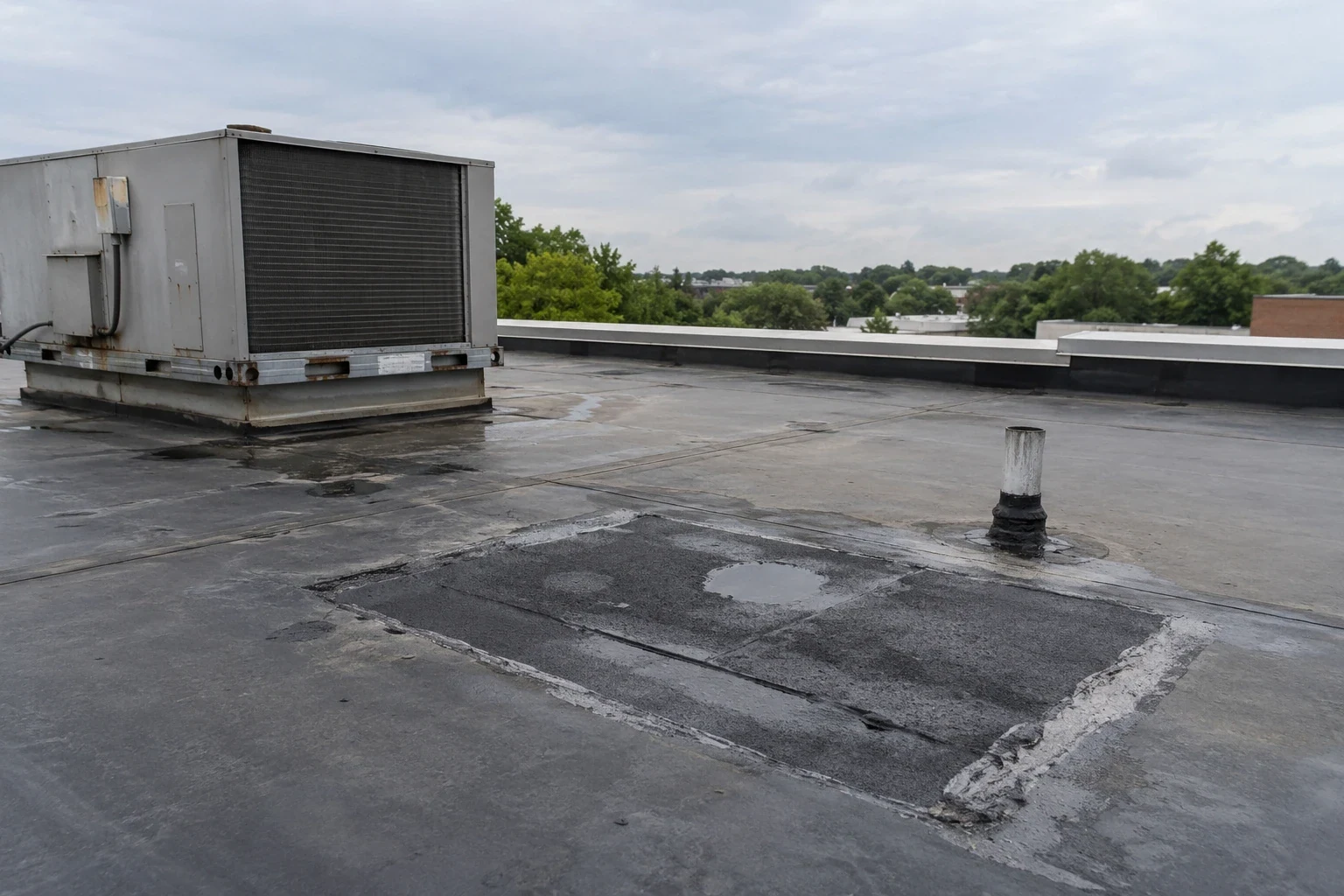
Every penetration is a hole with a seal around it. Rooftop units sit on curbs flashed on four sides, pipes pass through boots and vent stacks carry collars. Each seal has a shorter service life than the field membrane and fails in a familiar order: pipe boots first, then curb corners, then counterflashing sealants. We count the penetrations in each roof zone and probe each seal.
If a curb has moved, the flashing at its base is opened and the support below is checked, starting with the curb and its supports. A skylight or penetration flashing replaced before a leak appears costs far less than the interior damage after one.
Repair boundary: material and method
The repair boundary is drawn on the roof plan around the flashing being replaced, and it extends past the visible failure to the point where existing material is sound. We pull back old sealant and adhesive to find a solid edge before measuring. A boundary drawn too tight leaves the next failure two feet away.
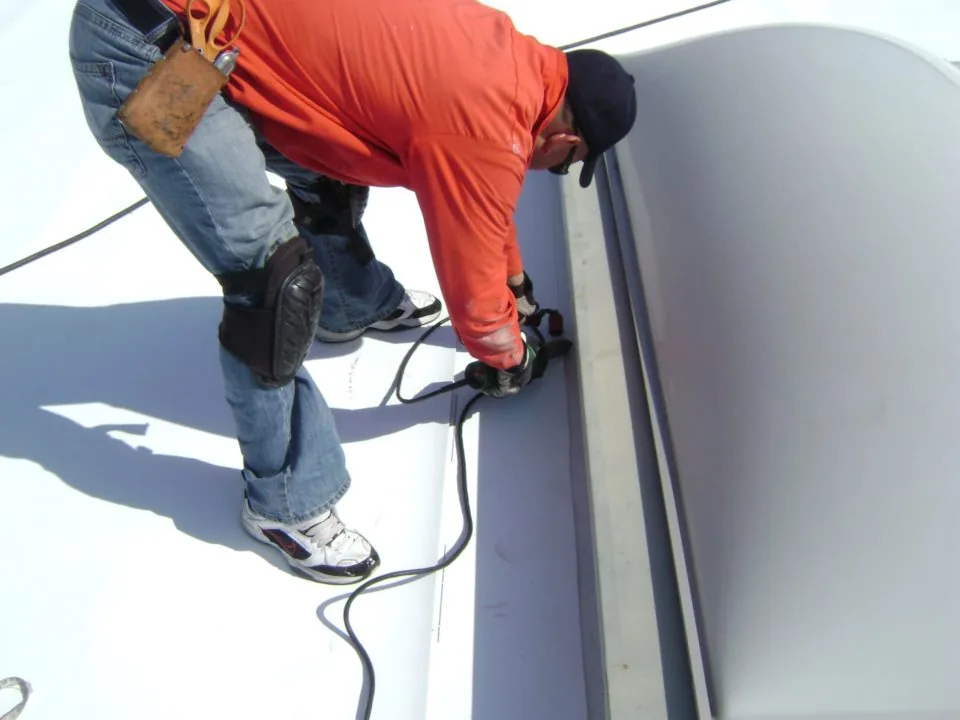
The repair material has to be compatible with the roof system. A heat-welded system takes welded corners and flashings. A bonded system takes the right primer and adhesive. A liquid-applied flashing resin suits complex shapes where a prefabricated piece does not fit, if the surface is clean and dry. Sealant alone is a finish, not a repair, and the record says which was used.
Compatibility is checked against the product data before a can is opened. A solvent in one sealant can soften a membrane that another would leave alone, and an adhesive that bonds well to one sheet can fail on another. When the existing material is unknown, a small test area shows how it reacts.
Moisture reading: where the water went
Water that gets behind a termination can travel a long way. A moisture survey maps wet insulation near the failed flashing, and a core sample confirms it. If the board is wet, closing the flashing is not enough, since wet insulation holds water against the deck and the next repair fails. The wet boundary joins the repair boundary on the plan.
The reading also separates a new failure from an old one. A flashing leak that has run for months leaves a larger wet area than one found within days of a storm, and the record gives the property manager that distinction for budget and claim purposes.
The reading carries a date and the weather in the days before it. Moisture moves with the season, and a survey after a week of rain reads differently from one after a dry week. Repeat the reading at the same spots later and the change in the wet area is plain.
Work coordination: access, tenants and weather
Metroplex storms peak in spring, and severe thunderstorms can follow a dry week without much warning. The work window for flashing needs a dry substrate and workable temperatures. A temporary seal goes on when water is entering, and the permanent flashing waits for a dry stretch. Tenant hours often limit roof entry at properties near I-35E and SH 121, and the access log records every visit.
Wind and water often share a cause. A flashing lifted in a gust, as seen after wind damage, lets water in at the next rain. A pond at a wall base, as in ponding water repair, fails a flashing sooner than a dry one. The record names both links when it finds them.
Interior protection runs in parallel. Ceiling tiles that have absorbed water are marked and removed where they hang, stock and equipment are covered or moved, and the access log notes who entered which space and when.
Closeout documentation: what the owner keeps
The closeout packet holds before and after photographs of each repaired flashing, the plan with the boundary marked, product data for each material and the follow-up date. A larger repair needs its permit checked against the edition and amendments of the 2021 IBC that Lewisville has adopted.
For owners with buildings around Old Town Lewisville and the I-35E corridor, the same packet works across the group. A leak repair report can list flashing items by building, which helps a property manager plan the next year's work.
Commercial Roofing Questions
Why does the leak show up far from the failed flashing?
Water travels along the deck, insulation joints and underside of the membrane before it drips. The stain marks the exit, so we trace it uphill to the nearest edge or penetration.
Is resealing a joint a permanent fix?
Rarely. Sealant ages in sun and heat. A lasting repair restores the mechanical termination or replaces the flashing, with sealant as the finish.
Which flashing fails first on most roofs?
Pipe boots and curb corners can fail ahead of wall flashing, so the walk probes them early and the record counts them by roof zone.
Can a flashing repair be done in a storm season?
A temporary seal can. Permanent flashing needs a dry surface, so it is scheduled in the next dry window.
What records support a warranty or claim?
Before and after photographs with dates, the plan marking the boundary, moisture readings and product data for the materials used.
Related
Related Roofing Work
Rooftop Equipment Curbs and Supports

Skylight and Penetration Flashing
Wind Damage Roof Repair
Ponding Water Roof Repair

Old Town
Commercial Roof Leak Repair
Schedule an inspection and get a dated record
Send the property manager's list of stain locations, access limits and any roof plans. We will return a dated condition record with photographs, findings and recommended next steps.