KEE Roofing in Lewisville, TX
Home // Roof Systems //
Overview
KEE Roofing in Lewisville
Some roofs fail not because of the weather but because of what the building above and below them puts into the air. KEE is a PVC-alloy single-ply membrane, built with a ketone ethylene ester modifier to resist plasticizer loss and to stand up to more grease, oil and chemical exposure than a standard PVC sheet. Seams are welded with hot air. In Lewisville, TX, where the Metroplex economy includes warehousing, manufacturing and corporate and computer services, roofs carry exhaust and process vents in many places, and a KEE membrane is a system worth pricing for the ones that do.
We begin a KEE review the way we begin any exposure case: list every discharge onto the roof, record where it lands, and photograph the membrane around it. The record decides whether the current sheet is holding, whether the source is controlled and whether the next roof should be a different material.
Roof zone: mapping every vent, hood and stack
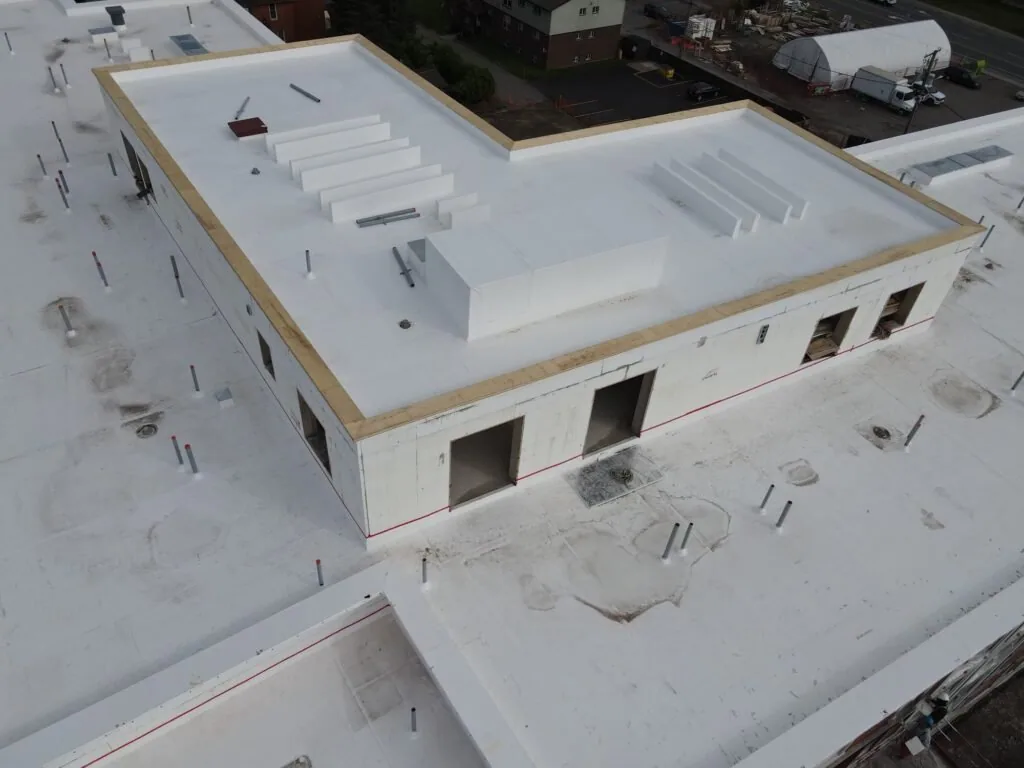
The roof plan for an exposure case marks every item that puts something on the roof: kitchen exhaust, process vents, fume hoods, generator exhaust, cooling tower drift, boiler flues and condensate drains. We note what each discharges, in which direction the prevailing wind carries it and how close it is to the membrane, then draw the zone around it.
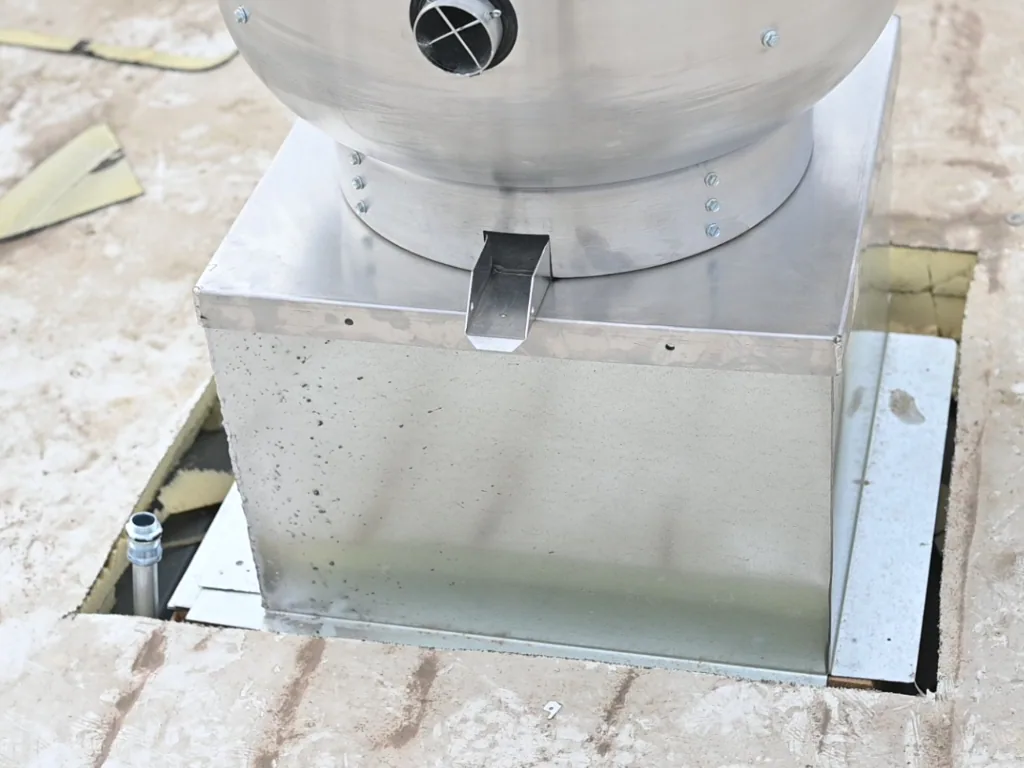
- Exhaust fans with grease or oil content, and the pans under them
- Process vents and stacks, with their height above the surface
- Condensate lines that drain onto the membrane
- Walk paths used to service the equipment
- Drains and low spots that collect what the vents deposit
Zones are tied to the photographs. A dated image of the staining pattern next to a note of the source makes a decision file that the manager, the tenant and a later contractor can all read. The map often shows that two or three sources account for most of the wear.
Evidence sequence: what the surface shows about the exposure
We photograph the whole zone first, then close in on the membrane. Discoloration, softening, tackiness, blistering and stiffness tell us how the sheet is reacting. A membrane that is tacky near a fan has taken grease; a stiff, shrunken edge near a stack may have lost plasticizer; a bleached patch may point to chemical vapor.
Where we can, we compare the exposed area with a clean area of the same roof. If the sheet beside the vent is as flexible as the sheet across the roof, the system is handling the exposure. If it is not, the difference is documented. Summer heat adds to the exposure: highs near 96 degrees at the airport in July and August, and roughly twenty days a year past 100, speed chemical reactions and plasticizer migration. The record keeps the heat and the exposure separate, so each is judged on its own evidence.
Inspection record: welds, flashings and the details that fail
The weld inspection is the same as on other thermoplastic sheets. We probe seam edges, look for continuous bead along each lap, check three-sheet intersections and inspect flashing terminations at walls, curbs and parapets. Field-formed flashings and prefabricated corners get close attention, since they are the places where a hand weld can be weak.
With a KEE sheet that has been in service some years, we also check how the surface has weathered, whether the sheet remains flexible and whether the edges are curling or shrinking away from a wall. Repairs to an aged sheet start with cleaning the surface down to a weldable layer, and we test a small area before committing to a larger repair. If the weld will not take, the record says so. This is how we avoid the common problem of a patch that looks fine for a week and lifts at the first heat cycle. A seam failure repair on a KEE roof is documented with probing at each end.
Repair boundary: when to repair around a vent and when to replace
If the sheet near a vent is flexible and weldable, a repair can hold. If it has softened or stiffened, the repair may fail beside itself. We set the boundary by testing weldability, probing the repair and looking for wet insulation. When the area near an exposure source is wet or the sheet will not accept a weld, the boundary is the full zone, and the repair is a new section welded to sound membrane beyond it.
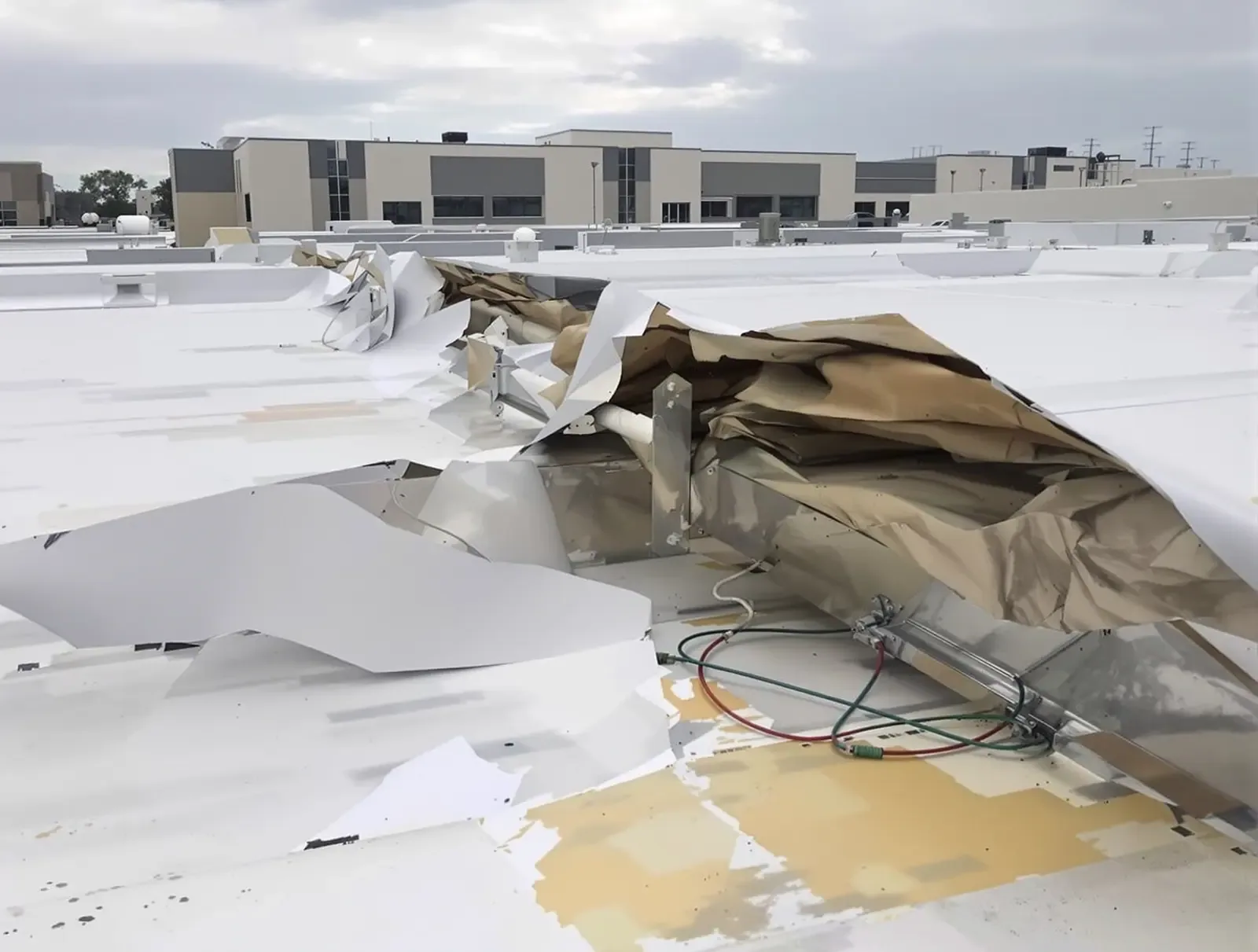
Hail is the second driver, and the Metroplex sees it almost yearly though not at every address. After a storm we mark bruises and punctures against older wear. A hail damage repair record on a KEE roof is routine when the sheet is dry and flexible, and the same record supports a claim if one is filed.
Options review: KEE against PVC, TPO and a coating
For a roof with heavy exposure, the comparison is usually among standard PVC, KEE and, for a roof with milder exposure, TPO. KEE and PVC alloys are chosen for chemical and grease resistance. TPO is chosen on cost and reflectivity where exposure is light. A coating restoration is possible on a sound, dry roof if the surface can be cleaned and tested for adhesion, though a coating over a heavily contaminated sheet can fail early.
We lay out the choices next to the exposure map, the moisture reading and the age of the current roof. The question for the owner is which system matches the exposure for the life of the building. Replacement is also the chance to correct the source by raising a stack, adding containment or relocating a fan. For a manufacturing plant roof or a distribution building with process vents, the exposure map is usually the deciding document. Tenants who change operations, adding a fryer, a new process line or a second exhaust fan, change the map too, so we ask the manager to tell us before the equipment arrives, and we update the zone drawing and the photographs at the next pass, with a date on each change so the map always matches the roof as it is operated.
Closeout documentation: the exposure and weld file
The closeout file lists the membrane type, how it is attached, the insulation, the flashing details, the seam test results and an exposure map with each source marked. It includes the weather and temperature on repair days, the cleaning method, the weld settings used in testing and photographs by zone before and after each repair.
Permit reviewers work from the edition and amendments in force at filing, and the city's adopted codes include the 2021 International Building Code. The file records permit and inspection dates. Owners with industrial sites near I-35E or in Denton can use the same file at each address.
Commercial Roofing Questions
What does KEE resist that standard PVC may not?
More plasticizer loss, grease, oil and chemical exposure. It is chosen where the roof sees those conditions over time.
Do the vents have to be moved?
Not always. Raising a stack, adding containment or redirecting discharge can reduce exposure, and the exposure map shows which changes matter most.
Can an exposed sheet be welded?
Only after cleaning, and only if a test weld bonds. If it will not, the repair boundary moves out to sound membrane.
Does hail affect KEE differently?
The effect still shows as bruises or punctures at impact points. The record marks them against older wear, so the cause is clear.
Does the code change a KEE replacement?
Only through the permit. The office sets the edition at filing, and the city's adopted list starts from the 2021 International Building Code with local amendments on top.
Related
Related Roofing Work
Split and Open Seam Repair
Hail Damage Roof Repair
PVC Roofing
TPO Roofing
Manufacturing Plant Roofing
Denton
Start with an exposure map
Schedule an inspection and receive a condition record with photos, an exposure map, weld findings and recommended next steps marked patch, repair or replace.